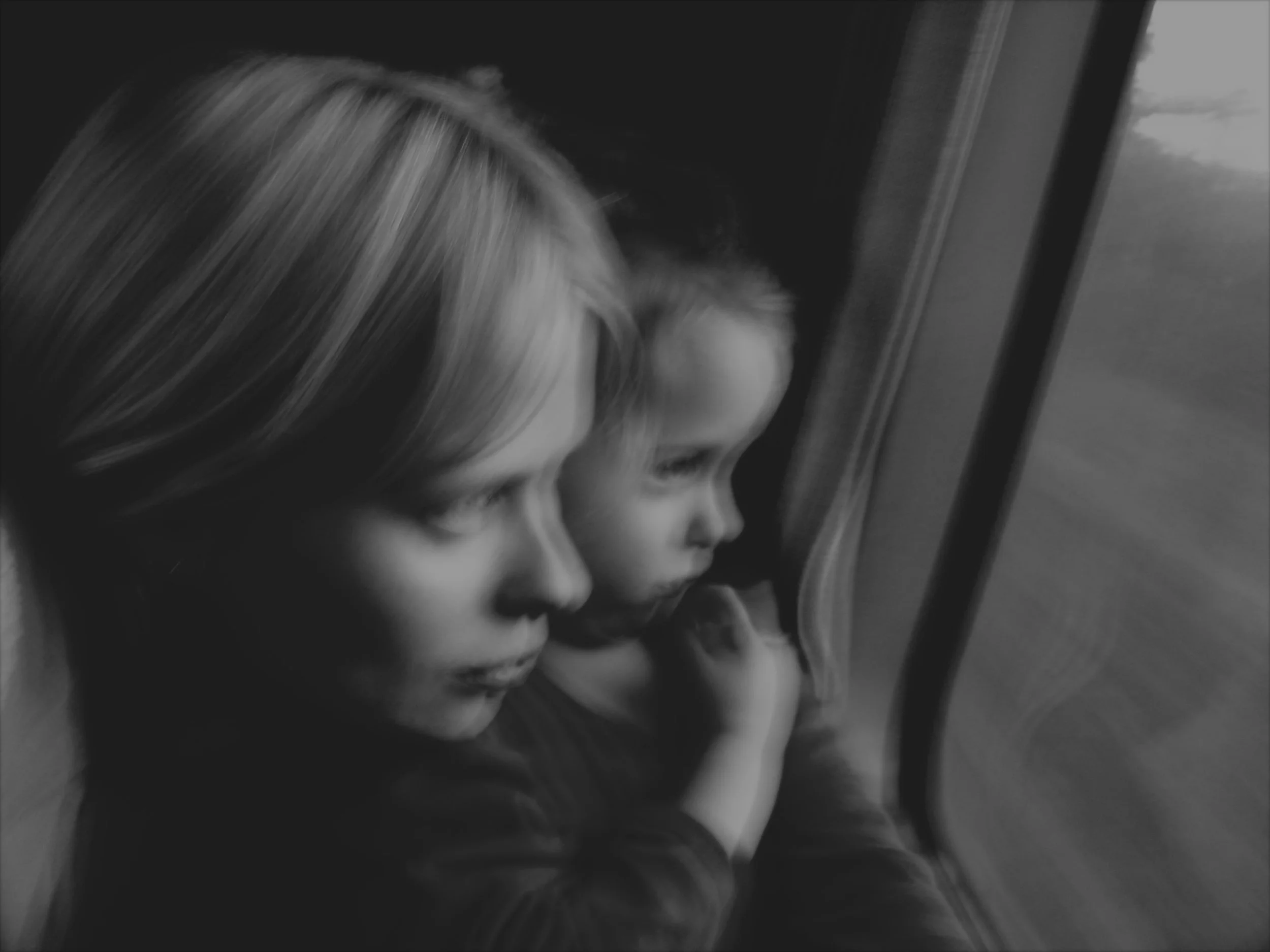
”Mother & Daughter watching the world go by” 200
OHISOPHY
a philosophy of seeing
Ohisophy is my understanding the world through attentive looking, where photography becomes a philosophical act of observing life as it passes.
The word ohisophy comes from the Finnish word ohi — that which passes.
My work begins with watching the world as it moves, as it lives and as i live within. Photography becomes a way of thinking through perception. The eye and the body encounter the world together, and each image emerges from that meeting.
This sections gathers notes, fragments and reflections from that ongoing practise of observing reality.
The philosophical questions explored in the essay “The Potential of Poetic Language as an Intrepreter of Reality” below, later evolved into Ohisophy, my practice of understanding the world through the act of looking.
The Potential of Poetic Language as an Interpreter of Reality
On Reality, Philosophy, and Language
(Paris, 2003)
Socrates asked us to close our eyes in order to see our inner beauty.
Wittgenstein, in turn, urged us to remain silent about that which cannot be spoken.
I would like to continue from that silence. Rather than speaking, I ask us to close our ears to the noise of everyday language and listen instead to silence.
Within silence, another form of language may be heard — an authentic poetic language that reaches where ordinary language cannot.
This essay examines the potential of poetic language as a way of approaching reality. Where speech reaches its limits, poetic language may continue.
Language and Reality
When considering the words philosophy, language, and reality, thoughts begin to move. Sentences, words, and letters drift before the eyes. Where do the ideas originate that help shape such reflections? Are they echoes from elsewhere, signals from the subconscious, or perhaps reality itself participating in thought?
For centuries philosophers have attempted to approach the essence of reality through language. Their task has been to seek the authentic — the most fundamental explanation behind every why.
Language opened the possibility of reflective thought for human beings. It is the path toward conscious thinking. Without words, would we even know what we think?
Yet this raises another question: as our vocabulary expands, does our thinking expand as well? Or does our capacity for thought already exist on another level that language cannot fully reach?
Wittgenstein famously argued that the limits of language are the limits of thought. Where language fails, conceptual thought has no path.
Yet human experience suggests that awareness may exist beyond these linguistic limits.
A child begins to think before mastering language, before uttering even a single sound. Language therefore may exist on more than one level. It is more than spoken or written expression.
If reality were confined entirely within our vocabulary, we would indeed be prisoners of language.
But is there reality beyond language?
Do the trees moving in the wind possess language? Do they understand themselves as reality?
Perhaps there are as many realities as there are thoughts.
The Limits of Conceptual Language
Philosophers such as Locke, Kant, Descartes, Jaspers, and Wittgenstein have attempted to clarify reality through conceptual language. Yet even these thinkers encounter phenomena that exceed linguistic description — matter, spirit, utopia, forces that cannot be fully explained through rational discourse.
Philosophy itself contains a paradox. It demands radical questioning, yet participation in philosophical discourse requires mastery of its conceptual structures.
At times philosophy risks becoming trapped within its own language — unable to see reality beyond its established terms.
If philosophers relied only on existing terminology, nothing genuinely new could ever emerge. Reality would remain confined within language itself.
Emotion, Imagination, and Knowledge
Human beings often demand rational explanations for everything. When phenomena cannot be explained conceptually, they are often excluded from rational discourse.
Yet our evolving existence continually encounters experiences that lack accepted terminology — at least terminology recognized by scientific institutions.
On the level of emotion and imagination, reality unfolds differently.
The moment before creation — when a painter confronts a blank canvas, a writer opens a new page, or a contemplative observer looks upon the world with a newly cleared mind — is a moment that exists beyond fixed language.
For each of them, their immediate experience constitutes the most real reality possible, interpreted through their own form of language.
Paul Feyerabend’s methodological anarchism reminds us that rigid scientific methods cannot account for every discovery. His principle — anything goes — allows both science and art to move beyond established frameworks and encounter new realities.
Art and Poetic Language
Art involves immediate perception. To understand art requires sensitivity and emotion.
Art is a language of feeling.
Martin Heidegger argued that art reveals truth. Artistic expression may be the most authentic expression available to human experience.
Poetic language offers a way for emotion to appear within language. It may even be the only language capable of approaching the deepest forms of truth.
Everyday language, which Heidegger described as increasingly impoverished, can obscure reality. Familiar words and concepts easily become invisible through repetition.
Poetic language, by contrast, displaces perception. It lifts us to an unfamiliar vantage point from which reality may be seen anew.
Silence and the Inner Language
Wittgenstein concluded his Tractatus with the well-known proposition:
“Whereof one cannot speak, thereof one must remain silent.”
Yet silence may not be an ending.
Sometimes vision becomes clearer in the mist. Paradoxical or ambiguous language can open entirely new worlds.
Artistic expression often emerges from authentic emotional experience — realities that cannot be logically ordered or conceptually reduced.
Poetic language therefore may function as a bridge beyond rational concepts and proven theories.
But in order to reach poetic language, we must rediscover emotion.
And we must rediscover silence.
s
h
h
ssshhhh
The noise of everyday language can make us not only blind but deaf.
Within personal silence we may hear another language — an inner language that arises from lived reality. A language that cannot always be spoken clearly, but can nevertheless be felt.
From this felt experience something authentic may emerge through art.
And the language of art remains poetic as long as it expresses something genuinely experienced from reality.
Poetic Language
Poetic language contains no fixed concepts, no predetermined theories, no gates or prescribed paths.
Within poetic language lies the potential for everything.
Each creative act becomes a response to reality — illuminated by what Ernst Bloch described as the dawn of possibility — where the human spirit learns to listen to the language of light.
(Paris, 2003)